Showing posts with label 17th Century Europe. Show all posts

Thursday, July 11, 2019

Blog Tour Spotlight: The Earl in Black Armor by Nancy Blanton

The Earl in Black Armor by Nancy Blanton

Publication Date: March 17, 2019
Ellys-Daughtrey Books
eBook, Paperback, Hardcover
Genre: Historical Fiction


Ireland, 1635.

When the clan leader sends Faolán Burke to Dublin to spy on Thomas Wentworth, the ruthless Lord Deputy of Ireland, the future of his centuries-old clan rests upon his shoulders. Wentworth is plotting to acquire clan lands of Connacht for an English Protestant plantation. To stop him, Faolán must discover misdeeds that could force King Charles to recall Wentworth to England.

Leaving his young daughter Elvy in the care of his best friend Aengus, Faolán works as a porter in Dublin Castle, and aligns with the alluring Denisa, Wentworth’s personal assistant. She, too, spies on Wentworth, but for very personal reasons.

While Faolán knows he should hate Wentworth, he admires his prosecution of pirates and corrupt nobles who prey on Irish merchants. Supremely arrogant and cruel to his enemies, Wentworth shows loyalty, warmth and compassion for family, friends and a few select others.

A common mission takes Faolán and Denisa from Dublin to London and Hampton Court; to York and Scotland; and to the highest levels of court intrigue and power. But secrets, fears, war and betrayal threaten their love—and even their lives. And as Wentworth’s power grows, so grow the deadly plans of his most treacherous and driven enemies.

"If you are looking for an adventure that will keep you on the edge of your seat, then look no further! Get ready for court intrigue, roguish behavior, and of course, that little bit of romance... Well, then you have a book that is hard to put down." -- Rebecca Hill, Net Galley Reviewer

Amazon | Barnes and Noble | IndieBound


About the Author


Nancy Blanton writes award-winning novels based in 17th century Irish history. Her latest, The Earl in Black Armor, tells a relentless story of loyalty, honor and betrayal in the Stuart era prior to the great Irish Rebellion of 1641. The Prince of Glencurragh, her second novel, occurs in 1634 during the English Plantation of Ireland. Her first novel, Sharavogue, is set in Ireland and the West Indies during the time of Oliver Cromwell. In non-fiction, Brand Yourself Royally in 8 Simple Steps is also a medalist, providing a valuable personal branding guide for authors, artists, and business consultants. Her blog, My Lady’s Closet, focuses on writing, books, historical fiction, research and travel. Ms. Blanton is a member of the Historical Novel Society and is proud to be an occasional guest author on the award-winning UK blog, Myths, Legends, Books & Coffee Pots. She has worked as a journalist, magazine editor, corporate communications leader and brand manager. Her books celebrate her love of history and her Irish and English heritage. She lives in Florida.

Tuesday, July 2, 2019

Blog Tour Excerpt: Severed Knot by Cryssa Bazos

Severed Knot by Cryssa Bazos
Publication Date: June 7, 2019
W.M. Jackson Publishing
Genre: Historical Fiction/Romance


Barbados 1652. In the aftermath of the English Civil War, the vanquished are uprooted and scattered to the ends of the earth.

When marauding English soldiers descend on Mairead O’Coneill’s family farm, she is sold into indentured servitude. After surviving a harrowing voyage, the young Irish woman is auctioned off to a Barbados sugar plantation where she is thrust into a hostile world of depravation and heartbreak. Though stripped of her freedom, Mairead refuses to surrender her dignity.

Scottish prisoner of war Iain Johnstone has descended into hell. Under a blazing sun thousands of miles from home, he endures forced indentured labour in the unforgiving cane fields. As Iain plots his escape to save his men, his loyalties are tested by his yearning for Mairead and his desire to protect her.

With their future stolen, Mairead and Iain discover passion and freedom in each other’s arms. Until one fateful night, a dramatic chain of events turns them into fugitives. Together they fight to survive; together they are determined to escape.

Excerpt:

The song ended, and Iain watched Alastair as he entered the crushing mill. He disappeared for a moment, and when he reappeared, he cradled a violin in the crook of his arm.
Iain couldn’t sit there any longer. Passing by the keg, he dropped the cup on top and manoeuvred through the crowd to head back to his hut.
Tam stopped him. “Where are you off to, Scotsman? You’re truly sour, man.”
“I’ve had enough.” Iain patted the man on the shoulder and attempted to move past him. Before he did, he glanced to the crushing mill in time to see Alastair handing the violin to Mairead. The rapt expression on her face made Iain pause. She handled the instrument reverently, as carefully as a woman cradling her bairn. Iain had never seen her eyes so round, her normally wary expression soft.
Mairead lifted the violin to her collarbone and adjusted her grip. She tried a few tentative plucks and adjusted the tuning until the chord sounded right. She lifted the bow against the strings and started to play. 
The sound that came from her violin was low, wistful and with a melody that stirred long-buried hopes. Both light and dark notes rounded each other out as she pushed the tune farther along. A low drumbeat joined in, and she adjusted her rhythm slightly to hit the rising notes with the downbeat.
Then the main melody started.
Iain knew this song. An old Scottish ballad, one of his favourites. It called to mind the longing of home. It had been the song that he had sung to himself during the gruelling journey from England.
How was it that she stood there playing that very song?
The melody had always stirred him, providing comfort during all those times he had been away on campaign, far from home. But Mairead’s rendition added layers he had never heard. The mournful tone of the violin spoke of the wind in the firs and smoky twilight clinging to the mountains. A flight of swallows darting in a cold twilight sky and the cry of terns riding a lonely sea breeze. It called to memory swiftly flowing burns bordered with purple heather, and the hope of love reunited.

Thursday, December 6, 2018

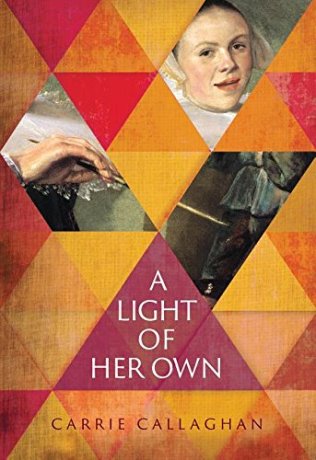
Blog Tour Q&A with Carrie Callaghan, Author of A Light of Her Own

Please join me in welcoming Carrie Callaghan to Let Them Read Books! Carrie is a fellow member of the Historical Novel Society Chesapeake Bay Area Chapter, and she is touring the blogosphere with her debut historical novel, A Light of Her Own. I recently had the chance to ask her a few questions about her protagonist, Dutch artist Judith Leyster, and the rewards and challenges of bringing Judith's story to life. Read on and enter to win a signed hardcover copy of A Light of Her Own!

In Holland 1633, a woman’s ambition has no place.

Judith is a painter, dodging the law and whispers of murder to become the first woman admitted to the prestigious Haarlem artist’s guild. Maria is a Catholic in a country where the faith is banned, hoping to absolve her sins by recovering a lost saint’s relic.

Both women’s destinies will be shaped by their ambitions, running counter to the city’s most powerful men, whose own plans spell disaster. A vivid portrait of a remarkable artist, A Light of Her Own is a richly-woven story of grit against the backdrop of Rembrandt and an uncompromising religion.


AMAZON | BARNES AND NOBLE | INDIEBOUND


Hi Carrie! Thank you so much for stopping by today! How did you first discover Judith Leyster, and what inspired you to write a novel about her?

In 2009 I was wandering the National Gallery of Art in Washington, DC when I came upon an exhibit of gorgeous oil paintings – by a woman. I love Dutch Golden Age painting, but I had never heard that a woman had painted then, much less succeeded at it. I wanted to know who this woman was and how she had managed to make her way during the time of Rembrandt.

Judith's talent did not come to wider public notice until the late 19th century, when it was discovered that her works had been erroneously attributed to another artist. Based on your research, do you think this was really an error or do you think she was purposely obscured?

I would guess that none (or few) of the dealers intentionally erased Judith’s authorship. However, sexism allowed owners to forget that their paintings were made by a woman, and sexism prompted later dealers to assume these beautiful works were painted by a man. I don’t think it was purposeful per se, but sexism is an effort by society to deny women power, and obscuring women’s work is part of the effect.

What was the most challenging aspect of bringing Judith's story to life?

There are so many small details about 17th century Dutch life that differ from our own, and sometimes figuring out how things worked was a tremendous challenge. How did they light lanterns? How late could people be out? Were Haarlem’s gates locked at night? What painting techniques did Judith use and where did she get her supplies? In addition to those technical details, there is very little we know about Judith’s life, so I had to take a few imaginative leaps.

Friday, February 9, 2018

Blog Tour Guest Post: The Soldier's Return by Laura Libricz

Please join me in welcoming Laura Libricz to Let Them Read Books! Laura is touring the blogosphere with her new release, The Soldier's Return, book two in the Heaven's Pond trilogy. I'm pleased to have her here today with a guest post about the inspiration behind the story. Read on and enter to win the first two books in the trilogy!

The year is 1626. A senseless war rips through parts of Germany. Ongoing animosity between the Catholics and the Protestants has turned into an excuse to destroy much of the landscape situated between France, Italy and Denmark. But religion only plays a minor role in this lucrative business of war.

The young dutchman, Pieter van Diemen, returns to Amsterdam in chains after a period of imprisonment in the Spice Islands. He manages to escape but must leave Amsterdam in a hurry. Soldiers are in demand in Germany and he decides to travel with a regiment until he can desert. His hope of survival is to reach Sichardtshof, the farm in Franconia, Germany; the farm he left ten years ago. His desire to seek refuge with them lies in his fond memories of the maid Katarina and her master, the humanist patrician Herr Tucher. But ten years is a long time and the farm has changed. Franconia is not only torn by war but falling victim to a church-driven witch hunt. The Jesuit priest, Ralf, has his sights set on Sichardtshof as well. Ralf believes that ridding the area of evil will be his saving grace. Can Pieter, Katarina and Herr Tucher unite to fight against a senseless war out of control?
​
The Soldier’s Return is the second book in the Heaven’s Pond Trilogy.

Amazon | Barnes and Noble | IndieBound


Inspiration behind the Heaven’s Pond trilogy
by Laura Libricz

On May 23, 1618, Protestant noblemen threw four Catholic lords out of a Prague Castle office window. The Catholic lords survived, supposedly having fallen into a dung heap. This year, four hundred years later, historians are celebrating the anniversary of that incident called the Defenestration of Prague, considered to be the beginning of the Thirty Years War. Deemed a war between the Catholics and the Protestants, all of those involved suffered torment and agony. One third of the German population succumbed during the war. They died either on the battle field, were murdered as innocents or perished from resulting diseases and hunger. 

For centuries, reformers had been known to protest the excesses of the Roman Catholic Church, their worldly rule and abuse of power and money. In the early 1400’s, the preacher Jan Hus from Prague spoke out openly against the church and its decadence. Bohemian aristocracy supported Hus, even after he was excommunicated. Although he had their support, he was executed in 1415, burned at the stake by the German king Sigismund. 

One hundred years later, Martin Luther set out to reform the Catholic Church as well. He was not intending to create a new one. The famed story reads that he nailed a document called the 95 Theses to the door of a church in Wittenberg in 1517. The main points of the Theses disputed and condemned the practice of the church selling indulgences to people in order to insure their souls’ entrance to heaven. This famous incident is credited to be the birth of Protestantism. Last year, 2017 marked the 500-year anniversary of that famous incident.